
Lake Stevens freezes. Not Minnesota-freezes, but enough — a few nights in the teens or twenties with water sitting inside a brass backflow assembly is all it takes. Water expands about nine percent when it freezes, and brass doesn't stretch. The result is the Pacific Northwest's signature spring surprise: you pressurize the irrigation system in April, and water sprays from a split body or a cracked bonnet.
Freeze damage is one of the most common reasons assemblies fail their annual test around here — and it's also one of the most preventable. The routine is simple and has two halves: what you do before winter, and what you check in spring. None of it replaces the annual test, but all of it makes the test go better.
A note on what winterizing isn't: draining the system doesn't test the assembly, and an insulated cover doesn't make a device freeze-proof. Think of winterization as risk reduction — it moves the odds strongly in your favor, which is exactly what you want from a device that has to pass a gauge test every spring. And if you need irrigation backflow testing in Lake Stevens, WA, spring startup is the ideal time to combine it with the seasonal check.
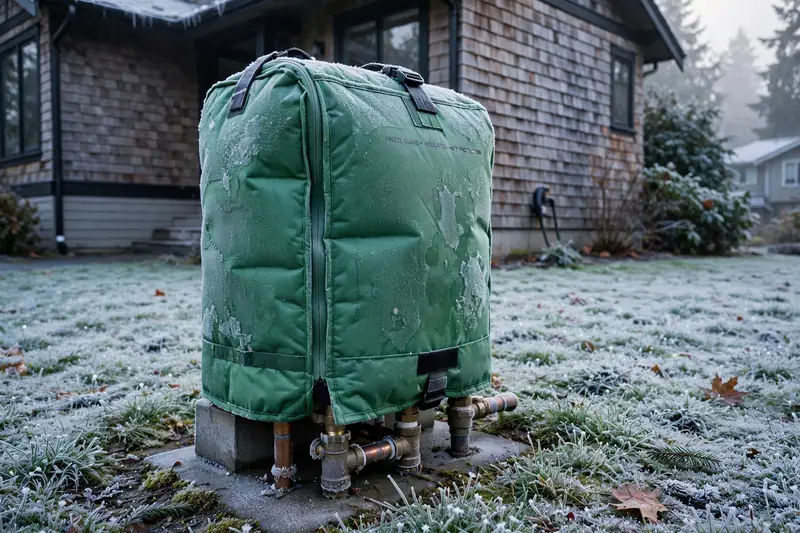
The Winter Routine: Before the Freeze and After
Before winter: drain and cover
Shut off the water to the irrigation system and drain the assembly — open the test cocks and let the water out so there's nothing inside to freeze and expand. If your sprinkler company blows out the lines with compressed air, coordinate with them; and remember that a PVB doesn't protect against compressed-air winterizing, so the blowout procedure matters for device selection too. Then cover exposed assemblies with an insulated enclosure made for backflow preventers — the fitted pouches, not a towel and a trash bag. They hold warmth from the ground and blunt the worst of the cold snaps.
During winter: leave it alone
Once drained and covered, the assembly wants to be left alone. Don't unwrap it to "check" in January — you'll just let the trapped warmth out. If we get an unusually hard freeze and you're worried, the cover is doing its job; there's nothing useful to do mid-storm.
Spring: inspect before you pressurize
Before the system goes back under full pressure, look the assembly over: cracks in the body or bonnet, weeping test cocks, damage to the cover. Then pressurize slowly and watch. If anything sprays or streams where it shouldn't, shut the assembly's valves and call — that's a repair, and it's the single most common spring service call around here. Then schedule your annual test at startup: one visit, system checked and compliance handled. Our guide to what a test visit involves covers the rest.
Questions About This Topic
Is an insulated cover enough to protect my assembly all winter?
No — nothing makes an exposed brass assembly freeze-proof, and anyone who promises otherwise is selling something. A proper insulated enclosure plus draining dramatically cuts the risk, which is the honest version of the claim.
I found a crack in spring — can it be patched?
No. A cracked body isn't repairable — epoxy and clamps don't restore a pressure vessel that's meant to hold check valves to test spec. A split body means replacement, followed by the required initial test and a filed report.
Does winterizing replace my annual test?
No. Draining and covering protect the device; only the field test with a calibrated gauge — and the report filed with the PUD — satisfies the annual requirement. Think of winterizing as protecting your investment in passing the test.
Should I shut off my irrigation water for the whole winter?
Yes — that's standard practice here. Shut the irrigation branch off at the assembly's valves (or the dedicated shutoff), drain the device, and leave the system depressurized until spring startup. Your home's water is on a separate path and stays on.
When should I winterize?
Before the first hard freeze — in the Lake Stevens area, that typically means late October into November, though the exact timing moves year to year. Watch the forecast: a single night in the low twenties with water in the assembly is enough to crack it. Earlier is always safer than later.
My neighbor never winterizes and never has problems — why bother?
Luck and exposure. A sheltered assembly behind a warm garage wall can dodge freezes for years; an exposed one on a windy corner might not survive one bad night. You're not betting against the average winter — you're betting against the coldest night, and that bet gets expensive when you lose.
Need Backflow Help?
Call FlowGuard — tell us what's going on and we'll take it from there.