
It's a fair question. The device is right there on the side of the house — brass, valves, a few little caps. Handy homeowners look at it and think: how hard can it be? The honest answer: for compliance purposes, you can't. Washington requires backflow assembly tests to be performed by a tester holding the state's Backflow Assembly Tester (BAT) certification, and the PUD only accepts reports from certified testers.
The deeper answer is why the state set it up that way — and it's not gatekeeping. A backflow test isn't checking whether water comes out. It's measuring tiny pressure differentials — a double-check valve's checks must each hold at least 1.0 psi — with a calibrated differential-pressure gauge, following exact procedures, and interpreting what the needle does when valves are manipulated in sequence. The difference between "holds" and "leaks" can be a few tenths of a psi, and getting it wrong in either direction has consequences: a passing grade on a failing device leaves the water system unprotected; a failing grade on a good device costs the owner a repair they didn't need.
That's why BAT certification exists as its own credential — distinct from a plumbing license. The exam, administered through Washington Certification Services at Green River College, has two parts: written, and hands-on, where candidates field-test four assembly types and diagnose simulated malfunctions. Testers also have to get their gauge kits independently lab-checked for accuracy at least every 12 months, and they file their certification details with every report. If you need backflow testing in Lake Stevens, WA, that's the apparatus behind the visit — and why the visit has to be done by a certified tester.
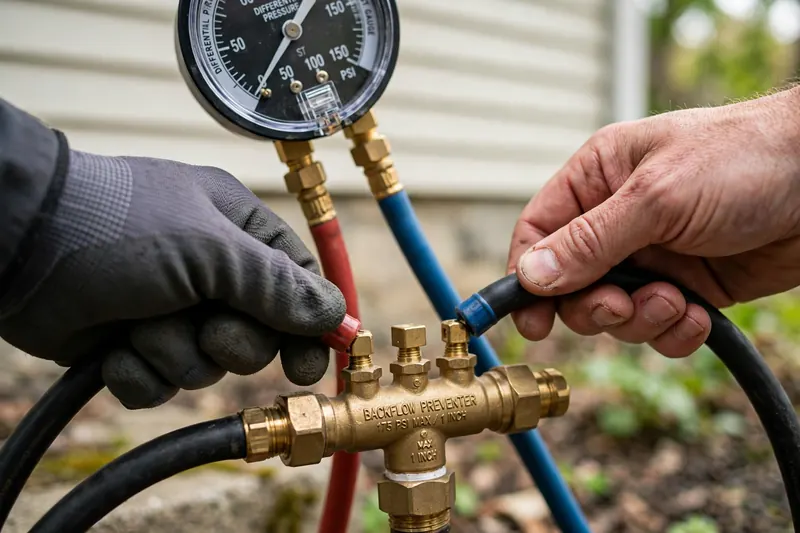
What the Test Actually Involves (and Why It Takes Training)
Here's the procedure, simplified. The tester identifies the assembly and notes line pressure, shuts the water briefly at the assembly's own valves, flushes the test cocks to clear debris, and attaches the gauge with hoses. Then, valve by valve: on a DCVA, each check is tested for tightness and differential; on an RPBA, check valve one, then the relief valve's opening point, then check valve two; on a PVB, the air inlet's opening point plus the check valve. Water goes back on, and the readings go on the formal report.
Every one of those steps has a wrong way to do it — a test cock opened in the wrong order, a bleed valve misread, air trapped in the gauge hose — and the wrong way produces a wrong reading that looks exactly like a right one. The training is what lets the tester know the difference. It's also why the state requires repairs to use original-manufacturer parts with a retest afterward: the whole chain, from gauge calibration to parts to paperwork, is designed so the filed report means something.
So: you can absolutely learn where your assembly is, what type it is, and what the report says — we'd rather you did. But the test itself, the one the PUD accepts, belongs to the certified tester with the calibrated kit. Our walkthrough of what happens during a test visit shows what to expect when they arrive.
Questions About This Topic
I own a pressure gauge — can I test it myself?
Not for compliance. Even with a gauge in hand, the PUD only accepts reports from WA DOH-certified BAT testers using kits with current lab calibration — and the report has to carry the tester's certification details. A DIY reading has no standing with the purveyor.
What exactly is BAT certification?
Backflow Assembly Tester — a credential issued by the Washington Department of Health under the waterworks operator rules. It requires passing a written exam and a hands-on exam (field-testing PVB, DCVA, RPBA, and SVB assemblies and diagnosing faults), and it's renewed yearly. It's a distinct credential from a plumbing license.
Can my plumber do the test?
Only if they personally hold BAT certification. Plenty of plumbers do — but the credential is what matters, not the trade. The person doing the test must be a certified Backflow Assembly Tester; that's what the PUD requires.
What happens if I test it myself and send in the numbers?
The PUD won't accept it. Reports have to come from a certified tester with a calibrated kit, and an uncertified test leaves you exactly where you started: with an untested assembly and no compliance record. Schedule the real test instead.
Where can I get BAT training?
Approved 40-hour courses run through providers like WETRC/Green River College, PNWS-AWWA, and Evergreen Rural Water, with the exam administered by Washington Certification Services at Green River College. It's a real professional credential — written plus hands-on — not a weekend seminar.
Is the BAT exam hard?
It's practical rather than tricky: a written portion plus a hands-on portion where you field-test four assembly types and diagnose simulated malfunctions. People who work with these devices daily tend to do fine; it's designed to verify competence, not to fail candidates.
Need Backflow Help?
Call FlowGuard — tell us what's going on and we'll take it from there.