
If you've ever looked at the brass contraption on the side of your house and wondered what the letters mean, this is the guide. PVB, DCVA, and RPBA are the three backflow assemblies Washington actually field-tests — the ones with test cocks a certified tester hooks a gauge to every year. They all do the same job — stop water from flowing backward into the public supply — but they do it differently, and they're matched to different hazards.
Quick refresher on why they exist: backflow happens two ways. Backsiphonage is a vacuum in the water main — from a main break or heavy hydrant use — that can siphon water backward out of your pipes. Backpressure is your side pushing harder than the supply — a booster pump or thermal expansion, for example — forcing water back into the main. Either one can pull irrigation water, with its fertilizer and whatever else, into drinking water. The assembly's check valves are what stand in the way.
All three types need annual testing at the owner's expense under Snohomish County PUD's program. The differences are about which hazards they handle and where they can be installed. Here's each one in plain English — plus, at the end, the twist: the one common irrigation device that skips the annual test entirely.
The Three Assemblies, Explained
PVB — Pressure Vacuum Breaker
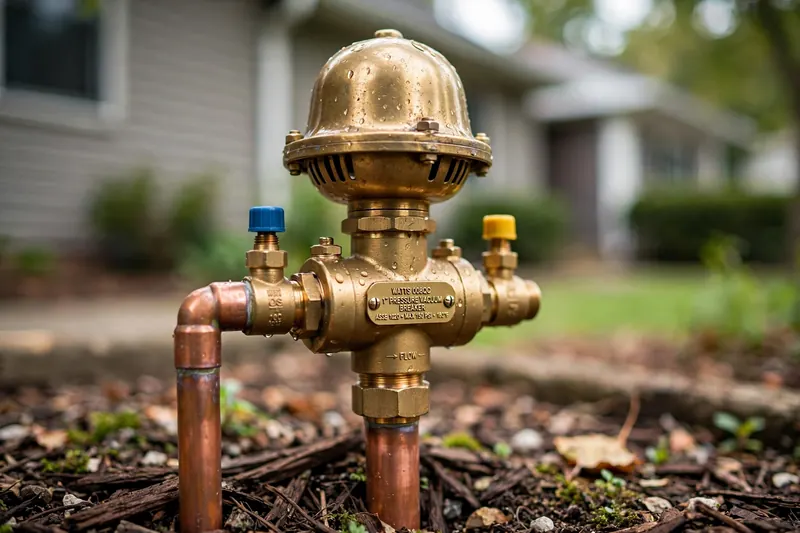
The one you'll see most on Lake Stevens homes. A PVB guards against backsiphonage (not backpressure) with a spring-loaded check valve plus an air inlet that opens to break any siphon. It's for residential irrigation without chemical injection. Installation rules: it must sit above ground, at least 12 inches above the highest point of irrigation piping. What it doesn't handle: flooding, backpressure, elevated piping, or compressed-air winterizing — the state's guidance is explicit that a double-check assembly is the minimum where those exist.
DCVA — Double Check Valve Assembly
Two spring-loaded check valves in series, each of which must hold at least 1.0 psi differential to pass. It's for irrigation without chemical injection where the layout doesn't suit a PVB — and unlike the PVB, it protects against backpressure too. It can go below ground as long as the test cocks stay plugged and accessible for the annual test.
RPBA — Reduced Pressure Backflow Assembly
The highest level of protection of the three. Two check valves plus a relief valve between them that dumps water if either check leaks — that occasional discharge you might see is the valve doing its job. Required where the hazard is high: irrigation with chemical injectors or pumps, commercial boilers, industrial uses. It must stay above ground so the relief valve can't submerge, and it usually gets an insulated enclosure for freeze protection.
The twist: the one that skips the annual test
The atmospheric vacuum breaker — AVB — is the one common irrigation device Washington does not require to be field-tested every year. The state rule requires it to be inspected at installation, after repairs, and after a backflow incident, but there's no annual gauge test. If your "assembly" is a set of small AVBs rather than one of the big three, that's why nobody's ever scheduled a test for it. Not sure what you have? We identify the backflow preventer on your Lake Stevens property during every visit.
Questions About This Topic
Which one do I have?
Look at the device: a PVB has a distinctive bell-shaped bonnet on top; a DCVA is a more compact inline unit with two check valves; an RPBA has a visible relief-valve vent between the checks. The make and model are stamped on the body. Still unsure? We identify assemblies during every visit.
Can I swap my PVB for a DCVA myself?
Device selection isn't DIY territory — the purveyor determines whether the protection is adequate for the hazard, and the test itself must be done by a certified tester. If you think your assembly is wrong for the hazard (for example, a PVB on a system winterized with compressed air), talk to us before changing anything.
Why does my neighbor's assembly look different from mine?
Different hazards, different devices — or different eras of installation. A home with a fertilizer injector needs an RPBA where the neighbor's plain sprinkler system gets a PVB. As long as each assembly suits its hazard and passes its annual test, the difference is normal.
Does an AVB ever need any attention?
Yes — just not the annual field test. AVBs must be inspected at installation, after any repair, and after a backflow incident, and they have their own installation rules. If you're not sure what type you have, a visit settles it.
Which assembly is cheapest to maintain?
Simpler devices have fewer parts to wear: a PVB is the simplest of the three, an RPBA the most complex. But "cheapest" is the wrong way to choose — the hazard decides the device, not the maintenance bill. An under-protected hazard isn't a saving; it's a liability.
How long do backflow assemblies last?
Decades, with maintenance — brass bodies outlive their rubber parts many times over, which is why rebuild kits exist. What ends an assembly's life is usually a cracked body (freeze damage), obsolete parts, or repeated failures. The annual test is what tells you where yours stands.
Need Backflow Help?
Call FlowGuard — tell us what's going on and we'll take it from there.