
The tester finishes, looks up, and says the words nobody wants to hear: it failed. Take a breath — a failed backflow test is a diagnosis, not a disaster. It means one of the assembly's check valves (or the relief valve, on a reduced-pressure assembly) didn't hold during the field test, so the device can't currently be relied on to do its job. What happens next is a defined, finite process.
Why do assemblies fail? The usual suspects, in order of how often they show up: debris — a grain of sand or a flake of scale lodged under a check disc, holding it open a hair; worn rubber — discs, O-rings, and seats that have hardened or taken a set with age; weakened springs that no longer snap the checks shut with enough force; a tired relief-valve diaphragm on RP assemblies; and, in the Pacific Northwest, freeze damage — water left in the body over winter expands and cracks the brass, and the leak appears at spring startup.
Here's the part that matters: a failed test doesn't mean an automatic replacement. Debris often just needs cleaning. Worn rubber and springs are a rebuild kit and an hour's work. The decision between repair and replacement follows clear rules — which is what the rest of this guide covers. If you're dealing with a failed backflow test in Lake Stevens, WA, the path back to compliance is: diagnose, fix, retest, file.
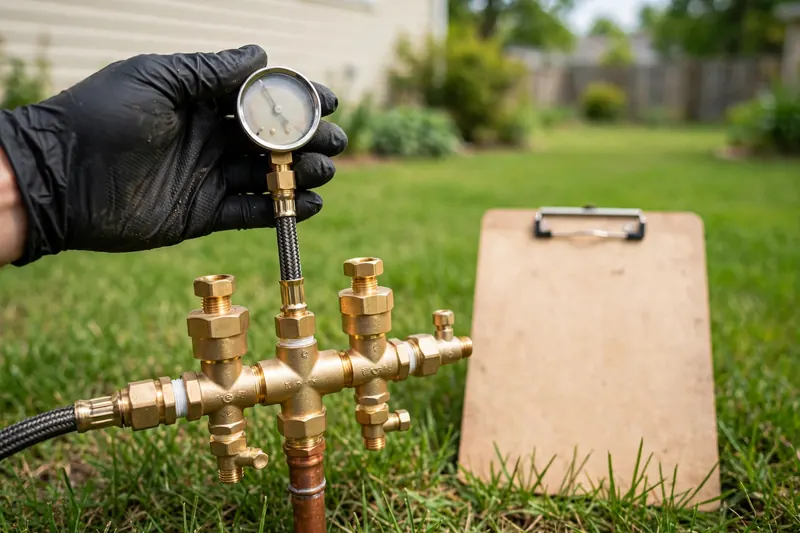
The Road Back to Compliance: Repair, Retest, File
Step one is the diagnosis, and you already have most of it — the test report shows exactly what didn't hold. A check valve that leaks at low differential points to debris or a worn disc; a relief valve opening at the wrong point points to the diaphragm or spring. The tester can usually tell you which it is on the spot.
Repair vs. replace — how it's decided
Repair wins when the assembly is an approved model and original-manufacturer parts can restore it. Washington's rules require factory parts for repairs — no generic substitutes — and a rebuild with new discs, O-rings, springs, or seats followed by a passing retest is the most common outcome.
Replacement is required when the unit isn't an approved model and can't meet the conditions, when it's been moved, or when it can't be restored with original-manufacturer parts. The purveyor can also require replacement if the protection is inadequate for the hazard. And if an assembly keeps failing test after test, the purveyor can require more frequent testing — at which point a new unit is usually cheaper than the repair-retest treadmill. Our repair page covers the decision in detail.
The retest is the finish line
This is the step people miss: the repair alone doesn't restore compliance. The assembly must be retested, it must pass, and the new report must be filed with Snohomish County PUD. Only the filed passing report closes the loop. Keep your copy with your home records — it's your proof if the PUD follows up.
Questions About This Topic
Will my water be shut off because my test failed?
Not on the spot. Shutoff is the PUD's tool for cross-connection hazards that go uncorrected — a failed test starts a repair timeline, not an instant disconnection. Fix it promptly and get the passing retest filed, and there's no interruption.
How long do I have to fix it?
The PUD sets the timeline for your situation, so treat it as soon, not someday. Practically speaking: schedule the repair or replacement right away. Every week a failed assembly sits is a week you're out of compliance, and a small problem doesn't get cheaper with time.
My assembly failed two years in a row — is it done?
Possibly. Repeated failures are exactly the pattern that pushes the decision toward replacement — especially since the purveyor can require more frequent testing for assemblies that keep failing. If two rebuilds haven't held, a new unit is usually the economical answer.
Can I still use my sprinklers while the assembly has failed?
The assembly sits on the irrigation branch, and the failure means that branch isn't protected right now. The practical move is to get it fixed promptly rather than running the season on a failed device. Call (425) 548-1928 and we'll talk through the timing.
Should I get quotes from multiple companies?
That's reasonable for a replacement, less useful for a test — a field test is a fixed procedure with a fixed outcome, not a bid. For repair work, compare the diagnosis: a company that can tell you which valve failed and why is giving you information; one that jumps straight to "replace everything" without a diagnosis isn't.
Will my homeowner's insurance cover the repair?
Typically no — insurers treat backflow assemblies as maintenance items, like a water heater's anode rod. Check your policy if the failure caused water damage elsewhere, but the rebuild or replacement itself is almost always out of pocket.
Need Backflow Help?
Call FlowGuard — tell us what's going on and we'll take it from there.